
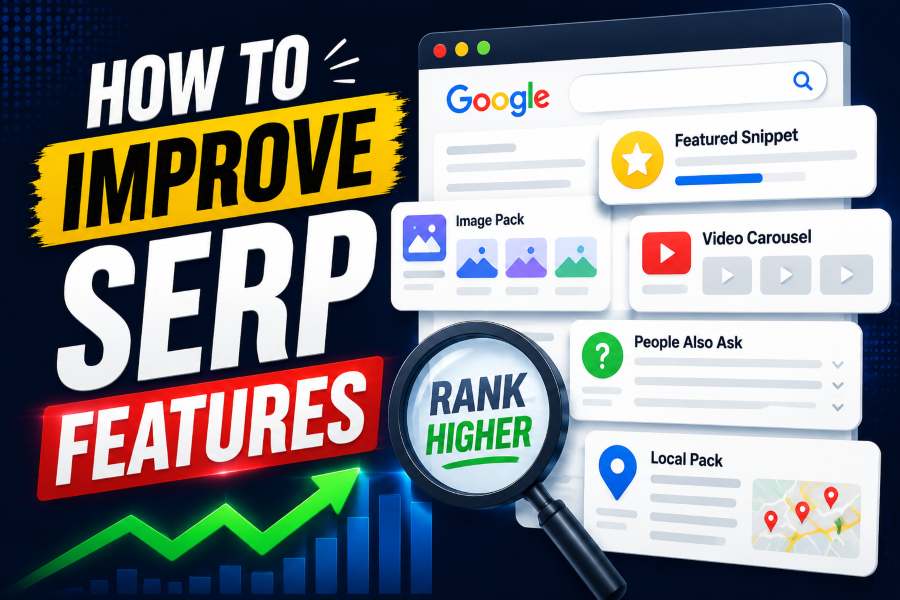
To improve SERP features, create the clearest and most useful answer for the search intent, make the page easy for Google to crawl and understand, and support the content with accurate structured data where relevant. Strong headings, concise definitions, original evidence, descriptive images, internal links, and reliable technical performance all improve eligibility. However, no tactic guarantees a featured snippet, rich result, People Also Ask placement, image pack, video result, or AI-powered citation. Google decides which presentation best serves each search.
A practical strategy starts with the search results that already exist. Study the formats Google rewards for your target query, then build a page that answers the same need more completely, accurately, and efficiently. The objective is not to copy competitors. It is to understand the result type, identify missing value, and publish a stronger resource.
What SERP Features Are and Why They Matter
Search engine results pages are no longer simple lists of blue links. Depending on the query, a user may see featured snippets, People Also Ask boxes, local packs, image results, video carousels, product details, review stars, breadcrumbs, top stories, knowledge panels, discussion results, or AI-generated summaries with supporting links. These elements are commonly called SERP features.
Winning a SERP feature can increase visibility even when a page does not hold the first traditional organic position. A concise answer may appear above standard results. A product page may display price and availability. A local business may appear with directions, opening hours, and reviews. An article may receive a larger image treatment or clearer date information. The value is not only ranking. It is occupying more useful visual space and giving searchers a stronger reason to click.
The right target depends on the query. A service business should prioritize local results, strong snippets, sitelinks, reviews, and relevant FAQs. An ecommerce site should focus on product and merchant information, image quality, availability, shipping details, and trustworthy reviews. A publisher should emphasize article clarity, author information, original images, video, topical depth, and answer-focused formatting.
Audit the Current Search Results Before Editing Your Page
The fastest way to improve SERP features is to begin with a live SERP audit. Search the primary keyword in an incognito window, but remember that results can still vary by location, device, language, and time. Record every visible feature and the pages currently included.
Look for patterns. Does the featured snippet use a paragraph, numbered steps, a table, or a definition? Are People Also Ask answers short and direct? Do ranking pages include videos, original diagrams, calculators, or downloadable templates? Are local results dominant? Does Google appear to prefer category pages, service pages, product pages, or educational guides?
Next, compare your page with the winning formats. A long article may still underperform if the answer is buried. A short service page may fail because the query expects a detailed guide. A technically valid schema implementation may produce nothing if the visible content does not support the markup. The audit should therefore examine format, intent, depth, trust, freshness, and technical eligibility together.
Create a simple worksheet with the target query, current features, winning URLs, answer format, content type, notable media, schema type, and gaps you can fill. This turns a vague goal into an editorial plan.
Match the Search Intent More Precisely
Search intent is the purpose behind the query. Most searches have an informational, commercial, transactional, navigational, or local purpose, although many combine several. Google selects SERP features that help users complete that purpose quickly.
For an informational question, lead with a direct explanation and then expand. For a comparison query, use clear criteria and a fair side-by-side structure. For a process query, provide ordered steps. For a local service query, make location, availability, proof, and contact options obvious. For a product query, show specifications, price, stock, shipping, returns, and real customer evidence where appropriate.
Do not force one page to satisfy every possible intent. A page targeting “best email marketing software” should not read like a generic definition of email marketing. A page targeting “SEO agency in Singapore” should not hide its service area and conversion path below 2,000 words of theory. Precise intent alignment improves rankings, engagement, and the chance that Google can extract a useful answer.
Use an Answer-First Content Structure
Pages that earn prominent search treatments usually make important information easy to identify. An answer-first structure helps both readers and search systems understand the page.
Begin major sections with a direct response of roughly two to four sentences. Follow it with context, examples, limitations, and action steps. Use descriptive headings that mirror real questions without filling the page with awkward keyword variations. Where a process matters, use a numbered list. Where comparison matters, use a table. Where definitions matter, write one clean sentence before adding detail.
For example, a section titled “What is competitor backlink analysis?” should define the term immediately. A section titled “How to reduce image load time” should present the most effective actions before discussing browser behavior. This does not mean every paragraph must be short. It means the user should not need to search through the page to find the promised answer.
Add a brief summary near the top, but avoid duplicating the entire article. A useful summary states the conclusion and key actions. It should encourage deeper reading rather than replace the page.
Improve Titles, Headings, and Search Snippets
A strong title communicates the topic and benefit without exaggeration. Keep the primary keyword natural, place the most meaningful words early, and make the promise specific. Avoid repeating the same keyword in the title, every heading, and every paragraph.
Your meta description should summarize the page accurately and give a reason to visit. Google may use page content instead of the supplied description for a particular query, so the visible introduction and section openings must also be well written. Treat the meta description as a useful pitch, not a guaranteed snippet.
Headings should describe the information below them. Generic labels such as “Overview,” “More Information,” or “Our Solution” provide less context than headings such as “How structured data supports rich results” or “Why PageSpeed scores change between tests.” Good headings also make content easier to scan and can help search engines identify passages that answer related questions.
Add Structured Data Only When It Matches Visible Content
Structured data is a standardized way to describe entities and page information. It can make a page eligible for supported rich-result experiences, but eligibility is not the same as guaranteed display.
Choose markup that matches the actual page. Common examples include Article, Breadcrumb, Organization, LocalBusiness, Product, Review, Event, JobPosting, Recipe, SoftwareApplication, and VideoObject. Use complete and accurate required properties. Recommended properties can improve context, but inaccurate data is worse than a smaller, correct implementation.
The information in structured data must agree with what users can see. Do not mark up reviews that are not displayed, invent ratings, add misleading prices, or use a schema type simply because it produces an attractive preview. Validate the implementation with Google’s Rich Results Test, inspect deployed URLs in Search Console, and monitor enhancement reports for errors.
For WordPress sites, a reputable SEO or schema plugin can simplify implementation, but plugins still require configuration. Check for duplicated schema from the theme, page builder, ecommerce plugin, and SEO plugin. Conflicting entities, multiple primary organizations, or incorrect page types can weaken clarity.
Strengthen Image and Video Eligibility
Images often influence click-through rate and can create additional search visibility. Use original, relevant images when possible. Name files descriptively, compress them, serve appropriate dimensions, and write useful alternative text that explains the image’s purpose. Place important images near the content they support and use descriptive captions when a caption adds context.
For article pages, use a high-quality featured image with a strong aspect ratio that remains clear on mobile. Avoid placing critical text only inside the image. Google and users should be able to understand the topic from the page text as well.
Video can be valuable for demonstrations, tutorials, product walkthroughs, and expert explanations. Give the video a descriptive title, provide supporting text or a transcript, create a clear thumbnail, and place the primary video prominently. A page with an embedded video but almost no supporting context may be less useful than a complete tutorial that offers both formats.
Build Entity Trust and Topical Authority
SERP visibility improves when a site consistently demonstrates who created the content, what the organization does, and why the information is trustworthy. Add accurate author or reviewer information where it helps readers. Maintain a complete About page, contact details, editorial policies, and transparent business information.
Topical authority is not created by publishing hundreds of shallow posts. Build connected resources around the problems your customers actually face. A digital marketing agency might create a central SEO guide supported by articles on keyword research, technical audits, internal linking, local SEO, structured data, backlinks, and measurement. Link these pages together with descriptive anchor text.
Original experience is especially valuable. Include screenshots, tested workflows, examples, templates, before-and-after observations, or expert commentary. Do not invent case studies or performance claims. Real evidence separates a useful resource from a generic rewrite of existing pages.
Improve Technical Eligibility and Page Experience
A page cannot earn stable search visibility if Google cannot access, render, index, or understand it. Confirm that the canonical URL returns a successful status, is not blocked by robots.txt, does not contain an accidental noindex directive, and is internally linked from crawlable pages. Use the URL Inspection tool to check Google’s indexed version and live accessibility.
Keep important content in the rendered HTML. JavaScript can be indexed, but unnecessary complexity may delay discovery or create rendering differences. Ensure mobile users receive the same essential content and structured data as desktop users.
Performance matters primarily because slow, unstable, and unresponsive pages frustrate visitors. Optimize large images, reduce unused scripts, limit third-party code, prevent layout shifts, and use caching and a content delivery network where appropriate. Do not remove useful features merely to chase a perfect laboratory score. Improve the real experience and measure results with both field and lab data.
Earn Links and Mentions to Important Pages
Structured data cannot replace authority. Competitive pages often need credible links and mentions. Promote original resources to people who would genuinely benefit from them. Digital PR, expert contributions, partnerships, resource pages, unlinked brand mention reclamation, and data-led content can earn relevant links without manipulative tactics.
Link building should support pages that deserve attention. A thin page with aggressive outreach may earn temporary links but still fail to satisfy users. Invest first in a resource with a clear reason to cite it, such as a useful study, detailed guide, template, benchmark, tool, or unique viewpoint.
Internal links also matter. Link from strong, relevant pages to the target page using natural anchor text. Avoid placing dozens of identical keyword links in footers or unrelated articles. A logical internal structure helps users explore the topic and shows which pages are central.
Measure SERP Feature Performance Correctly
Track more than average position. In Search Console, review impressions, clicks, click-through rate, queries, pages, devices, countries, and search appearance filters when available. Compare equivalent periods and annotate major content, technical, or algorithm changes.
Use rank-tracking software carefully because feature detection varies by location and tool. Confirm important results manually. Monitor whether the target page is gaining impressions for related questions, whether clicks improve after snippet changes, and whether conversions justify the traffic.
A page can lose clicks while gaining impressions if the SERP answers more of the question directly. In that case, evaluate business outcomes and create content that gives users a reason to continue, such as a template, tool, detailed comparison, expert analysis, or service path.
Common Mistakes That Limit SERP Features
The most common mistake is treating schema as a shortcut. Markup helps describe content; it does not make weak content authoritative. Other problems include answering the main question too late, copying the structure of a competitor without adding value, using inaccurate dates, hiding key content in tabs that do not work reliably, publishing low-quality images, and creating FAQ sections with repetitive or invented questions.
Another mistake is optimizing only for one feature. Search results change, and a featured snippet can disappear. Build a page that remains valuable as a standard result, an AI citation, an image result, or a source for related questions.
Finally, do not make dramatic changes every few days. Search systems need time to recrawl and reassess content. Make meaningful improvements, request indexing when appropriate, document the change, and evaluate over a reasonable period.
A 30-Day Plan to Improve SERP Features
During the first week, identify ten priority queries and record the current SERP features, intent, competing pages, and content gaps. Select pages that already rank within reach or support important commercial goals.
In the second week, rewrite introductions and major sections using answer-first formatting. Improve headings, add missing examples, update outdated information, and strengthen internal links. Create original visual assets for the most important pages.
In the third week, audit technical accessibility and structured data. Validate markup, remove conflicts, check canonical tags, inspect mobile rendering, and correct indexing issues. Improve the largest performance problems that affect real users.
In the fourth week, promote the strongest resources, reclaim relevant mentions, and begin monitoring impressions, clicks, feature ownership, and conversions. Continue the process monthly rather than treating SERP optimization as a one-time project.
Frequently Asked Questions
Can I guarantee a featured snippet with schema markup?
No. Featured snippets are selected by Google based on the query and available content. Structured data can support specific rich-result types, but it does not guarantee a featured snippet or any other special appearance.
How long does it take to improve SERP features?
Minor changes may be reflected after recrawling, while broader authority and quality improvements can take weeks or months. The timeline depends on crawl frequency, competition, site quality, and the significance of the update.
Should every page include FAQ schema?
No. Use only structured data types that Google supports and that accurately match visible content. An FAQ section can still help readers even when it does not qualify for a special search treatment.
Do Core Web Vitals directly create rich results?
No. Core Web Vitals do not automatically produce rich results. They are part of page experience and can support overall search performance, but content relevance, quality, accessibility, and eligible markup remain essential.
What is the best first step for a small business?
Choose a small set of high-value queries, study the existing results, improve the page that best matches the intent, and make business information consistent. For local companies, also strengthen the Google Business Profile and location pages.
Final Thoughts
Learning how to improve SERP features is less about chasing a visual trick and more about making content easier to trust, understand, and use. Start with search intent, provide a direct answer, support it with complete information, and ensure the page is technically eligible. Add accurate structured data, strong media, internal links, and real evidence where they improve the user experience.
Promnexa helps businesses turn these principles into a measurable SEO system. A focused audit can identify which pages are closest to winning stronger search visibility and which technical, content, or authority gaps should be addressed first.